HOM:

Giving you something to read on the toilet since 2009.

"The mistake lies in seeing debate and discussion as secondary to the recovery of meaning. Rather, we should see them as primary: art and literature do not exist to be understood or appreciated, but to be discussed and argued over, to function as a focus for social dialogue. The discourse of literary or art criticism is not to recover meaning, but to create and contest it. Our primal scene should not be the solitary figure in the dark of the cinema but the group of friends arguing afterwards in the pub."
-Don Fowler (1996) "Even Better Than The Real Thing"

Monday, May 21, 2012

A Touch of Greatness - Joel Scott Davis


“And this our life, exempt from public haunt,
Finds tongues in trees, books in the running brooks, Sermons in stones, and good in everything.”
William Shakespeare, As You Like It, Act 2, Scene 1

One of the more frequently discussed films to have previously graced the pages of this blog (according to HOM’s power rankings, it’s currently in a three-way tie with Melancholia and Hunger Games for the coveted title of HOM’s most-blogged-about film) is Spike Jonze’s cinematic reimagining of the classic children’s book Where the Wild Things Are. The plot is a familiar one: a young boy flees from the traumas of reality, seeking refuge and free reign among the benign beasts that inhabit his imagination. Themes of youthful innocence, curiosity, rebellion, camaraderie, and uninhibited creativity combine into a poignant ode to that which is irrevocably lost and left behind in the inevitable process of growing up.

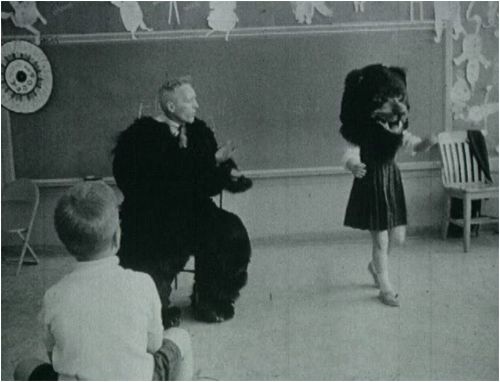
In the 2004 documentary A Touch of Greatness, we are witness to a true story in which the yawning chasm between childhood innocence and grown-up experience has been bridged in an extraordinary way. Surprisingly, the setting for the film is not the innermost realms of a child’s imagination; rather, our story unfolds in the seemingly ordinary confines of a public elementary school classroom in Rye, New York. Within this liminal space, for a brief season spanning the 1950s and early 1960s, a group of young school children were fortunate enough to encounter and engage with Shakespeare, Lincoln, and Sophocles in an unconventional manner: rather than exchanging their youthful dreams for a life-dulling, mind-numbing mediocrity and cookie-cutter conformity, these students instead become the recipients of an education that connects the fantastic with the factual, the poetic with the prosaic, the beautiful with the mundane. But how, you might ask, is such a reversal of the oft-watered-down public school experience possible? Who was responsible for creating such an unexpected spark in such an ordinary environment?

Meet Mr. Albert Cullum, a real-life hero whose highly idiosyncratic approach to elementary ed. blessed the minds, talents, and imaginations of each student who came through his classroom. For those pessimists who continually perpetuate the stereotypical view that “Those who can’t do, teach,” Mr. Cullum initially appears to be yet another stereotypical statistic: as a failed actor, he once made a fateful decision while walking along NYC’s fabled 42nd street to find another place where he could go to become a star. To his credit, however, his decision took on infinitely greater significance when he vowed that he would instead go some place where he could make everyone else around him a star. Such altruism was the lifeblood of his pedagogy, and his unorthodox, life-changing methods of opening young minds comprise the heart and soul of this touching documentary film. 

With his dramatic flair, slightly mischievous attitude, and a dash of whimsy, Mr. Cullum embodies the Teacher we all long for, but all-too-rarely encounter: he is the real-life, actualized potential of the ideal seen in Dead Poets Society, The Emperor’s Club, [insert inspirational educational film reference here]. Unlike these cherished movies and screenplays, however, the story of Mr. Cullum is real. His students exist as real people with real lives and stories of their own; in light of this, the highlight of this movie, for my money, occurs during the final 5 minutes, when we get the proverbial “Where are they now?” montage, and Mr. Cullum’s lasting influence on future generations comes into full display. (For the record, this film’s closing sequence, with its stirring Penguin CafĂ© Orchestra musical accompaniment, ranks right up there with the memorable dĂ©nouements of That Thing You Do!, Napoleon Dynamite, The Royal Tenenbaums, and any season finale from The Wonder Years). 

In the end, most of Mr. Cullum’s former students may not have gone on to become elder statesmen/women, A-list celebrities, high-paid athletes, Met opera stars, or award-winning persons of letters; nevertheless, they have each gone on to live lives of meaning and influence in their own respective corners of Anywhere, America, and you can tell that Mr. Cullum taught them an all-important lesson in contemporary culture: to search for that beauty and truth hiding between the covers of a book, or encoded within a mathematical formula, or buried deep inside a historical narrative, and to go forth and share these treasured findings with others. As Mr. Cullum so eloquently reminds us, “Learning’s not painful; learning should be joyful.” Amen, and amen.

Tuesday, May 15, 2012

Anti-War Movies - Jiro, Baseball, Restrepo

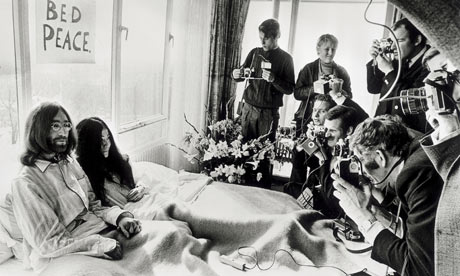
John Lenon and Yoko Ono making Bed Peace. The
documentary in which this protest is featured is memorable.
Also, "All we're saying, is give peace a chance" will get
stuck in your head for days. I suppose there are worse
tunes to be hummin'. 
Jiro Dreams of Sushi is a tightly wound, buttoned-up documentary about a man named Jiro and his pursuit of perfect sushi. Roy Tin Cup McAvoy would counsel as EU politicians amidst austerity measures might-- "perfection is unattainable." It's also a war movie. Baseball, the longwinded, robust documentary from Ken Burns is divided into 11 parts (innings). I'm both embarrassed and thrilled by how much time I've spent watching this documentary and loving Garrison Keillor narration. Most of the 25 hours hinge on war, as does baseball. Restrepo was filmed in "the most dangerous place in the world," Afghanistan. It follows a group of Marines into this place--nothing else though, just war.

New French President, Francoise Hollande, representing
the Socialist party's return to power, meets with small business
owners in Tulle market. Complete with an austere agenda
and a name that American's are sure to hate, he'll be
leaning on Tin Cup style wisdom.
Jiro, Baseball, and Restrepo are war movies. The extent to which dosages of war are apporitioned in each varies. However, be it on a pristine, just wiped down, sushi [home] plate or a machine gun turret aimed at shadows, the impact of heaping servings of war is astounding. Not awesome, just astounding. And that's the point.

Jiro made its way to movie theaters and out of the mushy indie doc world because it is minimalist, shouts out to genre top dogs, enhances thoughts with thinker's music, and insinuates several really good questions sans behind-camera-narration. Insinuated question one: what is a good life? See. Good question. Jiro knows the answer and by way of convictions and nearly flawless attendance, PW style, he makes you wonder if he's on to something. That's why there is a documentary about him. Rick Warren claims to know the answer as well. That's why he is overweight, a millionaire, pro-war and still a pastor. It's a compelling story, this one.


Japan's snowboard team before the olympics. Kokubo
center, was fined for not being Jiro enough--he didn't
tie his tie correctly. Notably, Kokubo refuses to alter
his series of tricks in competitions though he rarely wins.
He claims that his tricks are cooler than Shawn White's
so he "stays the course."
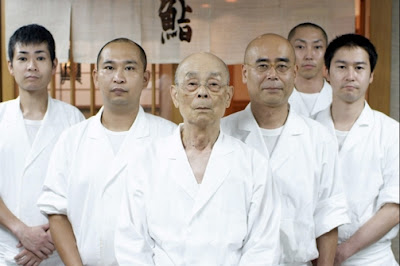
Jiro and his staff. His two sons immediately behind him.
His younger son was forced to open his own restaurant
while his oldest son (third from right is Jiro's apprentice;
he is in his 50s.


Jiro has pursued perfect sushi for 83 years. He works harder than every other sushi chef in the world. He demands complete surrender of himself and his employees. His restaurant is open six days out of seven. It is the only sushi restaurant in the world to receive three Michelin Stars. He is very Japanese, as the stereotypes would have us believe, and has not wavered but for two notable happenings and potentially, for a third. Happening number one: smoking almost killed him, had to spend some time in the hospital. Happening (potentially) number two: there is not going to be any fishes because we have over fished our oceans. The "California Roll" is supposedly the culprit. Happening number three: there was a great war. 
Ken Burns has 'an effect' named for him. His documentaries
are long and encompassing--a throwback to a generation
gone-by. His throwing form should not be used to
measure or pass judgement on his abilities to piece
together a throw-back documentary.
In this war, Japan attacked the United States, 
contributed to genocide, had a culture altering bomb dropped on their homeland. Whoa. From sushi to atomic bombs. Insinuated question two: what does a good life mean for one that works diligently in a post WWII Japan? (This is also a really good question.) Were this movie able to sidestep historical realities it would be less interesting. Many work diligently in utopia. We work diligently, though, in a society that for some terrible reasons, goes to war. One can't stop wondering, after seeing this really good documentary, firstly, what the hell has Jiro's wife been up to all this time? Secondly, how much of a response to WWII is the work ethic of Japan's 'Greatest Generation'? In another way, what's next for Japanese culture? Jiro dedication mashed-up with post-Nirvana expectations could be interesting. For real, check out their snowboard team and be inspired. Most of all though, keep your eye on David Gelb. This anti-war documentary has mostl likely catapulted him into Weinstein's office/palace and onto Red carpets.


In the last 20 years there has been a 218
percent increase in latino players in MLB.
Baseball is a little more overt than Jiro. It's a war movie and does little to hide the fact. What tips the viewer off to Ken Burn's Mel Gibsonesque aspirations is the trifurcated storyboard. Baseball before War and baseball after War and then baseball before War and then baseball after War and then baseball before War and then baseball after War. Luckily, for Ken Burn's sake, though he does get off on being exhaustive, we've managed to snuggle baseball close enough to corporate television contracts to keep it from going anywhere--come hell or high water. Though, I'm not sure MLB, ESPN, FOX and Obama are prepared for what would happen to professional baseball if a Hispanic/Latin country goes to war. Ken Burn's would have to leg-out this doc into a twelfth inning, I'd imagine.

A catcher/soldier trying-out for the Army
baseball team and embodying two things
that our nation does really well--war and baseball.
The point is that our nation loves two things: baseball and war. Burns, having spent most of his life with librarian archive specialists, weaves the two together with haggard footage of Babe Ruth "touching them all" and soft overtones of rich white men's quotes about the necessity of each, baseball and war. Leaving the Ken Burn's Effect aside, the viewer is left with a sour taste followed promptly be sweet nostalgia--Sour Patch Kid-like. "Ah, the days when baseball players, men paid little to make much for those at the top, were forced to go to war. That's when we knew what this country stood for." The identity inducing elements of America's pastime, war and baseball, in this documentary, opined on by Ken Burns, put this movie on the McArthy must-watch list.

A member of Second Platoon meeting with citizens of
the most dangerous place on earth, a valley in Afghanistan
home to Taliban (Rebels, Insurgents, Terrorists and
Monsters). Some of the most striking scenes in the
movie show the weekly meetings of Second Platoon's
leadership with village elders. The culture clash could
only be enhanced if the Sergeant were to hand out
California Rolls before explaining the rules of baseball.
Restrepo does nothing to hide from war genre epics. Complete with bullets, tattoos, hero sentiments, and a lack of remorse, Sebastian Junger and Tim Hetherington put the anti-war movement in the throes of real war. They bravely dig-in with the Second Platoon in one of the most crucial valleys in Afghanistan as the soldiers labor and shoot and labor and shoot. One of the most gripping and unsettling war movies ever made. In the first place, it makes one question Ken Burn's platform--all cozy and acoustically perfect. In the second place, it does well to usher forward the most pertinent question we should be asking, "What the hell are we doing there?!?!" I wonder if Jiro asked a similar question. Especially if he was stationed on Iwo Jima. Did he dream of sushi on that god forsaken island like the Second Platoon dreamed of cheeseburgers in that godforsaken valley? Maybe. Either way, Junger and Hetherington do not let up on a mission set in motion by anti-war documentarians before them. David Gelb, Ken Burns, Sebastian Junger and Tim Hetherington adhere to one theme: war dominates, sadly.


Friday, May 4, 2012

First Fiscal Quarter Mailbag

Dear HOM,

With Valentine's Day coming up, there's always the possibility of picking up a movie for me and the mrs. to watch. As a 27 year-old male, the problem is I struggle with "chick flicks." What do you recommend that won't make me want to (insert something gruesome)?

Thank you,
Lost in Louisville 

Dear L.I.L,

I have a tall friend that recently told me about a practice he and his wife make use of. They will go to the theater and plan on seeing two movies. They'll each pick one that they want to see that way each party is content enough. This takes time and money, though.

Here's the thing with "chick flicks", L.I.L. There are some worth watching. And this is where you'll need an expert. Next time she wants to queue up a love story, guide her towards some of these less gushy titles (notably, if the romcom features Hanks and Meg Ryan then your enjoyment is sure to be mutual):

When Harry Met Sally - The Holiday - You've Got Mail - Sleepless in Seattle - The Devil Wears Prada - Notting Hill - The Wedding Planner - Fool's Gold

There are many more and here is what I'd nudge you towards. Granted, she will have seen all of these. The great thing about a chick that likes chick flicks is that she'll most likely easily be swayed towards one that she knows is a sure bet, even if it is her 17th viewing. I'll stand by these above titles and add one more bit of advice. Flicks that feature McConauhey are usually superb for one reason - McConaughey. He'll provide genuine entertainment on so many levels. It's the absurdity that becomes the pursuit, you'll be on pins and needles waiting for him to come through with utter unbelievability.

Stay Strong, LIL, and muster up the courage to suggest the same 8 movies every Valentine's day for the next 40 years.

Yours Truly,

HOM

HOM,

The blog looks great. Thanks for keeping me up-to-date! The editor is sexy.

Anonymous

Dear Anonymous,

I have a suspicion that you are my sister. Thanks, I guess.

Peace,

Uncle HOM

Dear HashingOutMovies,

I haven't seen many foreign movies. I've never been excited about having to read subtitles for two hours. I'm wondering if I'm missing out on some good stuff. Can you recommend some foreign movies that are worth my time? Thanks,

American Joe

Privet! American Joe,

Great question! Jacked that you're willing to put in a little extra work to find some worthwhile movies. In the first place let me recommend a practice that I learned from an expert movie goer and lover of all movies - black, yellow, red and white. She taught me how beneficial it can be to watch all movies, english or sans english, with subtitles. Not only does it enhance the script but it also makes subtitles less intrusive. It becomes the norm to read subtitles this way. Some folks roll their eyes when I turn the subtitles on as if to say, "Seriously, could you do anything more cinephile?" I say, yes, I could and then they temper their scoffs for they know that I might watch three hours of extras before the movie starts, then watch the movie, then watch the movie with commentary on.

As to your question. Let me start with just a few that changed my life. Indeed, there are countless others that are worth laboring through two hours of reading but these would be a good start. They are compelling and will most likely ensnare enough of your attention with content to keep subtitles subdued.

Pan's Labyrinth - The best from Guillermo del Toro (one of the best of all time).
The Bicycle Thief - An older flick but the humanity of it trumps anything that might deter you.
Waltz With Bashir - Read up on the history of this one and then watch it - you'll be captivated.
Le Petit Soldat - A first rate thriller from the master Jean-Luc Godard. If you enjoy movies and have seen enough of them you'll notice how many scenes and shots and sorts of dialogue that he create.
Mesrine: Killer Instinct - Saddle up, this one is fast paced and features a top five actor, Vincent Cassel. You will not want to be gangster after this one.

There are so many more but this is a good start. Let us know how it goes.

Shalom,

HOM


I was talking with some friends the other day about the best movies about or featuring horses. I was wondering if you could weigh in on the debate/conversation. What's your favorite horse movie?

Thanks HOM,

Avid Rider

Avid Rider,

If "All the Pretty Horses" was not at the top of y'all's list then HOM won't have much to say on this matter. I'd have to mention "Wild Hearts Can't Be Broken" if I was going to talk about horses in movies. As much as I appreciated "Seabiscuit", I didn't love it - a little to heavy on the Disney. Slot "Black Beauty" just in front of "The Horsewhisperer" and you have a top five. Leave "Hidalgo" behind but be sure and talk about how brave of a movie it is. 

Toes Up,

HOM

HOM,

Picked up MI: Ghost Protocol last weekend...solid picture. Got me thinking about how the MI movies have gotten better as the series has progressed. 

In your opinion, which series - Bourne or Mission Impossible - has improved the most since the first installment? I know MI has one more movie than Bourne now, but I think we have a large enough sample size to decide.

And a bonus question - If you had to pick between Ethan Hunt and Jason Bourne for a one-man mission to save the world, who would you pick?

Thanks,

Lost in Louisville

Greetings to you and yours, LIL,


You've made some strong statements here. I've been thinking about them for like two hours. I came up with this in response:


Have they (Mission Impossible) gotten better? I mean, sure, they spend more money on each new installment and they do what they can to tip their hat to what worked in the previous flick. But I'm not sure that bigger explosions and wringing out excessive, clever quips makes it possible to deem the new superior to the old. I'd have to hear an awfully cogent hashing on how any besides the first is best. With that said, I've answered your first question only partly.


If MI has not improved then we need to establish if the Bourne's have improved. Here's the thing, I find the Bourne's to benefit from a level of pure devotion. Not only are they faithful to the books but they are faithful to mood and pace - two things of monumental importance for a thriller series. In this way, the Bourne's have not improved as much as they have remained (or attained) consistent brilliance. Each is as good as the last, the last is as good as the first. On this note, how do you feel about Jeremy Renner replacing Damon? I'm cool with it. I think the series needs a dose of fresh and I think Damon, himself, needs to move on from the roll that was made for him and he for it. It shall rest in time as one of the best.


Lastly, I'm not even sure that we need to think about this too long. The question could be asked a little differently, though. Do we want everything blown up in our hero's wake or do we want to leave no trace besides a series of prostrated dictators? I'd choose the latter which in turn points me towards Bourne. Sure, Ethan Hunt would be effective but I'd rather rest easy knowing that no one else on the planet knows that Bourne even exists. He also shows less emotion amongst a release of revolutionary information. Ethan gets volatile while Bourne keeps looking for whatever he was looking for. The only tip to the viewer that Bourne even heard the information would come in a brief glance from behind the scope of a sniper rifle or a split second stall. I'll take a stoic hero over a dramatic one any day. We probably can't lose though, can we?


Thanks LIL,


HOM

Sunday, April 29, 2012

Moneyball - A Conversation With Clink


HOM caught up with our newly signed baseball correspondent, Nathan Clinkenbeard. We talked baseball and movies. Clink has watched a lot of both.


HOM: Brad Pitt has never played baseball. I'm not even sure he knows how to play baseball. It was most obvious to me that this is the case when he stormed into the locker room and smashed the cooler with a bat. He then braced himself on his waist with the bat in his right hand. I almost felt bad for him for a second. It was the way he was holding the bat. The thinner handle part was in between his fingers, I think. The angle at which he was holding it, the way that it made him feel he had to do something with it. In another way, he just noticed that he was holding a bat. It was just all wrong. A baseball player, especially one as experienced as Billy Beane, would never notice a bat in their hands. And they would never split their middle and pointer finger with the handle. I'm pretty sure such a thing has never been done within 100 yards of a baseball field ever before. In the face of all that he did not know about baseball, Brad Pitt took on this role as GM extraordinaire, Billy Beane. Dude, Clink, tell me what you think about Billy Beane. Is his and the Oakland A's story worth a movie? Was it their story that attracted Brad Pitt to this movie? I ask because here's the thing with me: I'm not sure this story is that exceptional on any level. I mean, as a baseball fan, the A's and their use of "moneyball" is worth a few conversations. But here is what I want to know: is the book/movie just a mere semblance of an anti-establishment, come from behind, David & Goliath story? Has the story been enhanced for Hollywood-Michael-Lewis book/movie sale purposes? Or is this legit? How much attention should the casual (or devout) baseball fan give this story and this movie? To make this question even more wordy, is this movie even about baseball?

CLINK: First of all, thanks for having me on HOM. Been a big fan of the writings on here, and I'm glad I finally get the chance to contribute. Thanks for starting me out with about 10 questions in one. Moneyball is half baseball and half David & Goliath, anti-establishment. It's a decent story but overblown in several ways. What makes the story worth a movie is the persona of Billy Beane. Baseball players are the quirkiest of all professional athletes, and Beane's character definitely makes the movie. Would the movie be the same if Theo Epstein had been the A's GM? Absolutely not. It would probably be more like an episode of Doogie Howser, MD.

Baseball fans should not take Moneyball as the gospel. There's some merit to the story, but I'd say there's a lot left out as to why the A's were so successful from 2001-03.

Oh, and that Pitt scene you referenced was definitely hilarious. The guy wasn't an athlete, and he doesn't even like sports, which drops him down a few notches in my book. I also wondered what he had in place of his dip/chew. As an amateur in that field, I can't really grade him on his tobacco skills. 

HOM: What do you know about the history of Billy Beane's scheme? Was he the first one to use it? 

CLINK: I'm not sure you can say Beane was the first one to use it. Sabermetrics picked up steam in the mid 1990s, but Beane was really the first to make it and Moneyball "popular" in today's culture. He embraced the philosophy once his 2001 team was picked apart by other big market clubs. In essence, he needed to find a way to remain competitive with a small budget. What's loss in Moneyball is Beane lucked into having a few young studs that didn't have to be paid huge salaries. Looking at more recent A's teams, they have not been very successful at all. 

HOM:Similarly, let's talk about how freaking good that A's team washttp://en.wikipedia.org/wiki/2002_Oakland_Athletics_season I mean, Zito, Tejada, Byrnes, one Aaaron Harang, Tim Hudson, Chad Bradford. It's not like they won 103 games with a high school JV team, is it? What about these players?

CLINK: The middle of that lineup with Tejada, Chavez and Jermaine Dye was legit that year. The biggest misconception about "Moneyball" is the starting pitching for the Oakland A's that year. Michael Lewis didn't mention it in the book, and you only see a glimpse of Tim Hudson in the movie. Hell, in the movie you only see Tim Hudson getting shelled, so the uneducated baseball fan is probably thinking, "Man, that Hudson guy sucked, and they won despite him." Wrong. This team had the Big Three in Hudson, Zito and Mulder. These guys won 57 games between them, and Zito won the AL Cy Young in 2002. Does this team win 100+ games with the Cincinnati Reds pitching staff in 2002? No. The A's were lucky that these three stud arms were all young, and they only had to pay the three of them COMBINED just under $2 million. Zito himself only made $295K as the best pitcher in the AL that year! In my opinion, the Big Three should get significantly more credit than Moneyball for the success of that team. 

HOM: Once and for all, what's the impact of this movie/book on managers, GM's, and baseball?

CLINK: It hasn't had as big of an impact as the movie will lead people to believe. But then again, it's a movie, and there's always going to be a pinch of fiction and dramatization to spice up a true story. They flashed up on the screen that the Boston Red Sox won the World Series using Beane's philosophy, but what they don't tell you is the Red Sox still had a payroll beyond $100 million. Teams are applying some Moneyball philosophies, but they're not diving head first into the theory. It's like when you dip your toes into a pool to feel the temperature before you jump in.

The biggest impact has been the use of sabermetrics and most importantly, on-base percentage and on-base plus slugging throughout baseball. More and more experts use it now to determine a player's value as opposed to batting average. Most GMs, managers and scouts, though, have not bought fully into the Moneyball concept. These guys have all been in the game a long time, and most are too stubborn to accept a new philosophy. If Moneyball were to truly change the game, it would take an entire generational rollover to get it going. Maybe it will happen when we're using walkers and wearing adult diapers.


HOM: What about the Pitt - Jonah Hill combo? I mean Pitt was obviously the man in this movie but I don't think any of it works without Jonah Hill. He was pretty good, huh?

CLINK: I enjoyed seeing Jonah Hill step out of the comedy genre and deliver a believable performance as Beane's assistant Peter Brand. There were a couple times though where it looked like Hill was trying to be serious, and he was coming off as comical. Pitt and Hill seemed to have a chemistry throughout the film that made it work.

The guy I think is vastly underrated is Philip Seymour Hoffman. That guy can act. As a huge baseball fan, his performance as boring, monotone A's manager Art Howe was my favorite. He nailed it big time. 

HOM: I want to start a campaign to make a sequel to this movie. It will start out really melodramatic as Billy Beane takes on all this symbolism as a Christ figure, bound to suffer for what he believes in. But then, we find out that Ron Washington is being made manager of the Texas Rangers and the cameras decide to follow him to Texas where he meets the Bush family, Nolan Ryan, and Josh Hamilton - I mean could you get a better character driven plot? It'd be like Major League, but real. Your thoughts? I love Ron Washington is what I'm saying.

CLINK: It already sounds like a better plot than most of the crap Hollywood puts out most of the time. If you get the budget, I'll help write the screenplay. Any time you have GW, Nolan Ryan, Hamilton, Washington and Beane in a movie you're automatically set up for success. Ron Washington is definitely a character, and I wish we could have had a little more of him in Moneyball. 

HOM: As a baseball guy, where do you put this in the genre of baseball movies? Better than ________ but not as good as __________? Final thoughts?

CLINK: I know this flick received a Best Picture nominee, but there's no way I could put it up there with the all-time greats like Field of Dreams, Bull Durham, A League of Their Own, Major League I and II and The Sandlot. I'd have to put it somewhere in the middle tier, better than Mr. Baseball but not as good as For The Love of the Game.

HOM: Do the Reds make the playoffs this year?

CLINK: Let's just say I think it's going to be a lot harder than I originally thought at the beginning of the season. The bullpen has really taken a hit, but luckily they still have some very solid arms. My biggest concern is 3B and the production behind Votto in the lineup. That's what is going to make or break this team. If we don't get much from 3B and LF I think we'll be a .500 team. I believe they will get it done and make the playoffs.

Monday, April 23, 2012

Winter's Bone & Hunger Games

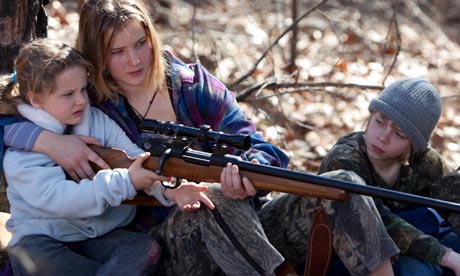
Jennifer Lawrence makes this movie more worth watching than it already is. Her ability to make you forget that you're watching a movie is what does the trick. The unceasingly gray sky, cold wind, and cold-hearted people push you into the swell. The strident chasing of fate and "doing what a woman's got to do" is cumbersome to watch. But Lawrence as the catalyst of hopeful determination sees you through the hard times. At one point I thought I could smell bacon that she was cooking in my kitchen--I was looking forward to getting out of bed and having her walk me to school. Motherhood was forced on her, as it is a lot of young people in mountain culture. Most don't make it to the other side. I never doubted her for a second. She was pure in her fulfilling of Mel Gibson era drama and I appreciated how much she wanted to save the trees. She pursued the sense of place and home that so many in that part of the country really do. She did it with integrity and respect.

She is good at hunting squirrels and as is true with many American youth that have to hunt for their food, it's always in the back of her mind that if things get real tough then she can join the Army and be all she can be. In the first run of Winter's Bone the Army recruiter turns Jennifer Lawrence away because she is too young and not prepared to kill people. In the second run of the movie the producers released an alternate ending. She does not find her father in the alternate ending. In this alternate ending times are even tougher and the Army recruiter forces all of the young girls and boys to converge on Main Street. There he decides that he needs two young people to kill other less-well-to-do youth. If she kills all of the youth that the recruiters tell her to kill then she'll get a new house for her family.

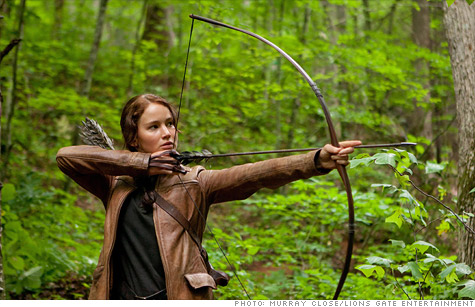
This alternate ending is a little more gut wrenching. Lawrence's sister is drafted by the Army recruiter - he seemed so helpful in his disguise in the original ending but here he seems more selfish and cold. In this one, Lawrence appropriately takes the place of her drafted little sister. She will go to war as a volunteer. No sign up bonus, only her cunning spirit and survival instincts will help her. She's rushed away to a lavish city (LA, NYC? It's never stated outright, it's just the Capitol) to begin her training. All the contractors and former killers were there to watch and train a new batch of underprivileged youth from ghettos and Appalachia. This alternate ending is a full two hours of additional footage so hold on to your hats and settle in, this ending takes you for a ride to a land no less bleak than Missouri hill country. This ending takes you to the land of tax breaks for the wealthy, reality TV obsessed cultures, and an arena smaller in scale than Afghanistan and Iraq but no less depressed.

The producers made so much money off this second release and alternate ending that they renamed the movie. They called it The Hunger Games. Winter's Bone is a synonymous title but with so much of the focus in this second version on killing in the face of hunger the new name seems appropriate. At one point I thought this new ending was a little far fetched. I kept asking myself if it was just an allegory or parable for the present or if this was really happening? I guess I just didn't want to believe that our nation would really condone the killing of teenagers by other teenagers. I'm told there are a bunch of books on the subject. My friends were just telling me about a documentary called Restrepo that they just saw. My friends and I often watch war movies and documentaries. We get all caught up in the love stories, manifest destiny and come from behind montages that wrap around the killing. I suppose we're not the only ones that love watching and reading about teenagers killing other teenagers. But still, this is so far fetched. I mean, really? There are rich white men sitting around campaigning for the killing youth to be given Oakley sunglasses and survival gear? These Hunger games must make as much money for the rich guys as a real war makes for other rich guys.

Both movies are worth seeing. Jennifer Lawrence has secured her place in our future of movie watching. We'll see her many times in the next 40 years. The original, Winter's Bone is hard to watch at times because you hate to see a young girl take such a beating. It all seems too real and unnecessary. In the second version of Winter's Bone with the extended/alternate ending, renamed The Hunger Games, Lawrence still steals the show and takes quite a beating. You may think each is far fetched if you've had no personal experience with poverty and war--they must always be mentioned together--but as far as I know, both The Hunger Games and Winter's Bone are as accurate as can be. Now, what do we do with it all? Are we cool with Appalachian youth having to grow up so quickly? Are we cool with watching Appalachian youth kill other youth on our TV and movie screens? The box office receipts from The Hunger Games and our willingness to engage in conflict in other parts of the world seems to point to an answer. From the safety of our blogs and webcams it's easier to point in another direction. We'll see if movies are overt enough to dictate future pointing, I guess.

Sunday, April 22, 2012

Shutter Island, Gustav Mahler and Music + Film

I can't believe I missed this movie while it was in theaters. I purchased my Dell A215 PC Multimedia speakers and subwoofer in 2001. I'm thankful for them. They've done their best to enhance several hundred movies that have played on my computer and they've done a pretty darn good job. But, man, they were the wrong choice for Shutter Island. I needed some Cypress Hill concert speakers.


Martin Scorsesee was honored this year at the Critic's Choice Awards with the Music + Film tribute, replete with Bob Dylan and Leo himself. Robbie Robertson has composed for Scorsese since they worked together in 1981. Robbie Robertson, I've learned from this article, has been listening to avant garde composers since the late 60s. Other movies have used bits and pieces from the avant garde, other directors and movie makers have been honored with the Music + Film tribute, but no movie and no movie director or movie maker has achieved what Robertson and Scorsese did with Shutter Island. Gosh, I love my speakers, but they were outmatched by the score-script combo of a tuned-in Robertson and the cultivated Scorsese.


There are two reasons to watch Shutter Island again. (Spoiler Alert) Shutter Island is a testament to the need for theater re-runs. This movie is like one of those pictures where there is more than one image to be seen. You know, the ones that show a rabbit and an old woman. It depends on your point of view which you see. Finishing the movie and then thinking back through it you'll recognize that everyone was in on the role play: the nurses laughing when Teddy is questioning them, the guard being nervous about one patient physically harming another, the frustration of the board of directors when Teddy barges in their meetings, and more. This is a cool way to make movies and Scorsese is all about making cool movies, of the noir-thriller-throw-back sort. The second reason to watch this movie again and maybe again, is to notice and really appreciate how the works of less famous composers are filtered in, layered and used in such a novel way, adding texture and not just CSI-X-files foreboding--"But the real brilliance of this score is that the music doesn’t cue the action or explain anything. It adds emotional texture, serving as an alternate universe for a film that has at its essence an alternate universe." 


Watch it again and notice where John Adam's "Christian Zeal and Activity" shows up. Pay attention to the use of Brian Eno and Lou Harrison. This will take some leg work as you'll have to listen to and read up on these folks. But then you'll start to realize how cool it is what Robertson has done with this score. You'll gain a whole new appreciation for how music can sit in a film or push a film or change a film or take over a film. Then you'll realize that Scorsese and Robertson don't use music for any  smoke and mirror reasons. It's used here to accompany, foster, and grow an idea - more honorable traits if you ask me. 


Lastly, Gustav Mahler. Composers have been featured many times in other movies. Most recently, without overt mention, though, in Melancholia. Implied but never stated was the line of dialogue: "Oh, you're listening to Wagner as the world is about to end in a fiery explosion of planets colliding?" Mentioning a composer is a way for movie makers to tip their hat to greatness. It's a way for movie makers to say, "Hey, this piece is so necessary for this movie that we are going to have the actors actually engage with the soundtrack." In other words, it's not a soundtrack, the characters hear and sense the mood changing for themselves. We, the actors, and the composers are on the stage together. Scorsese has seen bunches of movies where this has been the case. Before Tarantino and after Bergman, Scorsese makes use of what others have done well in movies that he likes. Robbie Robertson and Martin need the viewer to recognize what Gustav Mahler has meant for music, film and our culture. If anything, I hope you can appreciate this as much as I try to. Mahler was Austrian and was banned during the Nazi era. His work is known for being robust, novel, and unpredictable. He makes use of foreshadowing and in moments of dissonance he'll often do something completely absurd. The fact that Teddy recognized Mahler playing as he met the doctors in the throes of an elaborate role play is significant. For him, and for millions that lived with the atrocities of WWII, Mahler was a lynchpin in narratives constructed by sufferers who attempted to synthesize dissonance, atrocity, absurdity and beauty. Mahler's own tragic life can be heard in the piano quartet even having written it as a young student. Indeed, Mahler deserves a leading role in a high quality movie like this one.


Sometimes a thriller-horror movie strikes a chord on a personal level thereby placating the uneasy viewer. I was embarrassingly jacked about this soundtrack. I was able to stomach the creepy and embrace the broad strokes of Robertson's and Scorsese's awesomeness because of a score that did more than try and creep me out. It helped that the score featured a whole bunch of composers that I really enjoy listening to. I bet Joel Davis would have some cool stuff to say about this movie. We'll do our best to get him to weigh in on it all. 

Saturday, April 7, 2012

Melancholia - Responses & Retorts

Ben Franklin believed the most important question for fostering good conversation in his weekly pub gatherings to be:


"Have you met with any thing in the author [director] you last read, remarkable, or suitable to be communicated to the Junto? particularly in history, morality, poetry, physics, travels, mechanic arts, or other parts of knowledge?"


In the spirit of our B.A. Junto, here are some responses to HOM's tweets on Melancholia:


Response One:

This is one of the best HOM reviews yet. The twitter platform really works I think. It works well -- continuity of ideas but with a time-stamped notes -- very helpful, easy to follow.

I still can't decide if there's anything redeeming about this film. All the beautiful things are saturated with meanness, self-loathing, self-ishness. You're right - the sister seems to be the closest thing to a redeeming character.

Also, this review is full of gems, especially that death star reference -- I fucking agree so hard!

Response Two:

OK, some not very well thought-out thoughts:
Maybe it was just the mood I was in at the time but I actually didn’t find it totally depressing, I think people would probably do a lot worse things if they really thought the world was about to end. That aside, what did I like about it...


The first half, as a character study, was awesome – I thought Kirsten Dunst’s character’s depression was incredibly well portrayed, she was insanely frustrating but at the same time you couldn’t really be angry with her. I just felt incredibly sorry for her husband! Also loved her crazy eccentric parents. Granted a wedding was an obvious tool to make a lot of the family issues clear, but I liked that you could tell they had had all the same arguments a million times before – it may have appeared contrived but maybe it was meant to, because sometimes those situation are for real? Having said that, I do agree that some of the ‘rich people issues’ were very in your face.  However, I’m not sure I agree that the emotional scenes needed to become emotional – maybe they were deliberately like that – none of these people could communicate emotionally with each other effectively so the audience was left with the same feeling?


I thought there were a lot of good performances in it – Kirsten Dunst was awesome and should have been recognised in the award season (don’t even get me started on Drive). Charlotte Gainsbourg was equally as good in a part which, in my opinion, was a lot more difficult to shine in. I also loved John Hurst as their father (especially the spoons!).


As for part 2 - the sense of impending doom and claustrophobia were really well achieved - you really felt like there was no way out, that everyone was suppressed by the weight of what was about to happen. I found it more suffocating than depressing, and for that reason probably wouldn’t watch it again for quite some time. Having said that, it was one of the most memorable things I saw last year and here we are still talking about it now.... 

I have to say, there was also a lot I didn’t like – the opening shots and the scenes where Kirsten Dunst had lightning flying out of her hands etc didn’t really do it for me.  I’m also not really a fan of overly ponderous, not-much-happening-but-we-are-being-artistic moments, which may surprise you as this film had quite a lot of those. For some reason it didn’t feel too drawn out and slow to me – but I think that may be because I had bought into the world he created from the start and was wrapped up with their situation. If you stood back from it and tried to unpick it all maybe it didn’t work so well?

I think my personal fav comment of yours was the one about gravel :)

Wow, I hate overanalysing films. I always end up feeling like a pretentious idiot.

Response Three:

Great review!  The twitter works.  I especially like the multiple feeds(?) like the RedBox, and I'm down with the play-by-play style.  

To be honest, I wasn't really into this movie at first but liked it better in retrospect.  Dathalinn loved it, so I know there is redeemable stuff there.

It really shows that Von Trier has never been to America.  That's exactly how I picture some Danish dude to imagine the US of A.  Also, the thing I like best of this movie is it's depiction of the all-consuming nature of depression.  It covers everything and really is like the world's going to end.  So the idea of an utterly subjective, myopic kind of Earth is kind of cool.  But in terms of enjoyment and being pissed off about the "Earth sucks" and "God is nothing" message, I'm right there with Jone Bone.

That being said, it is kind of beautiful and thought-provoking.  So who knows?!

Response Four:

Dude, can't stop thinking about that fucking movie. Nytimes review is halfway persuasive, I think ebert generationally misses the point, and a whole lot of other commentaries are all over the place. I liked yours for the most part. Now that I am removed from the two hours where I actually had to watch such loathsome content and characters I am able to think about some of the dynamics. Particularly referring to Justine and Claire's relationship with each other, themselves, and others. I think there is a lot there that is kind of brilliant. I would be willing to unpack that statement if you asked me and I wasn't typing on my phone. At any rate, the female elements of this movie have my brain spinning. That is to say, my wheels are spinning, I am still not convinced that trier depicted these things very well and I still think his movies are too pompous and somewhat of a sideshow, vindictive even. Then again, he might have been bullied by my high school friends. In that case, I might should be a little more forgiving. Then again, I really don't like pomp. Or rich white guys. One love. 


Response Five:


Dude, what made you think I would care about this? Why'd you send me this? Duh. I've never heard of Lars Von whatever. I actually liked the movie though. I'm over it though. Twitter is weird to me anyways. Have you seen that freak ass movie with Bjork, gf just told me that's by the same director as this one was. That movie was sick*.


*This reviewer is from California. Sick, in this context, means that this reviewer thought that "freak ass movie with Bjork" was good. 

Thursday, April 5, 2012

Melancholia - A Tweeted Chronicling

@LarsVonT Dude, you're stuff is a bit intense for me but good friends have said I need to tough this one out. Still reeling from Dancer and the one with Defoe. #Scandinaviandirectors

@RedBox Picked up Melancholia at Thorton's new box down in Wilder by the river, appreciated the shade screen. Wonder why Cold Spring Kroger box was out of Melancholia #ColdSpringDeeperThanYouThink

@Melancholia (:03) Three mins in - lots of shots of paintings that tell me we are dealing with the inevitable, depression, and artistic longings. Hanging in there.

@Melancholia (:05) I'm always game for universe shots followed by portraits/close-ups. Kirsten D is good looking but already unnerved by her 'depression' face.

@Melancholia (:11) Ok, got it - rich people, spoiled girl with issues, pansy husband, Kiefer making career shift, big time british actors/thespians, shaky camera = I'm watching an existential 'film'.

@Melancholia (:20) Lars must have worked in service industry at some point, hate these rich idiots.

@Melancholia (:28) After 27 shots of foreshadowing Kirsten finally starts to break down - bout time.

@Melancholia (:39) I'd walk 18 holes here. The golf course and the shadows have the same effect - Lars takes the mundane and makes it eerie.

@Melancholia (:50) I'm over these characters. Part 1 was the most uncomfortable first act of any movie that I have seen in a long time. I'm givin it all I got, still waiting for the emotional scenes to actually be emotional and not so contrived.

@Melancholia (1:03) The sister is the only character redeeming this movie at this point. Her acting, in lieu of the looming planet smashing, is actually convincing. So glad this stupid, never ending party is over.

@Melancholia (1:16) Just checked how much time I have left before the movie ends - my stamina is wavering. HOLY BALLS! are you kidding? an hour left? FML.

@Melancholia (1:22) OK, that scene of walking around in the garden with cool light and decent tunes and then nude moon/melancholia bathing brought me back a little. I see where we are headed for first time in an hour. Snow scene was cool too. Lars is good at filming people just doing normal stuff like googling.

@Melancholia The sound of gravel is really prevalent in this movie. Wonder if that means some deep philosophical thing? Kind of sounds like pills in a pill bottle or something. ha. I want to set the horses loose.

@Melancholia (1:34) Ok, for realz, I need someone that likes this movie to start telling me what to look for. Really starting to get pissed off now. Just spent 12 minutes imagining how cathartic it will be once this planet doesn't exist anymore. This planet that VonT is depicting (earth) does not exist. Life on the Death Star was a more accurate depiction of humanity than this.

@Melancholia Why doesn't someone take her to the psychiatric hospital?

@Melancholia "The Earth is evil. No one will miss it." Really??? She's a soothsayer now?

@Melancholia (1:37) Still really excited to see what it would look like if two planets collided. Of course Kiefer has lanterns and stuff. And wears a tie and vest for the event. Can't stop trying to figure out the physics of this.

@Melancholia (1:43) The SciFi elements are redeeming this movie.

@Melancholia (1:47) Is this movie about happiness? Imagine the worst thing possible and everything is easier?

@Melancholia (1:48) Fake out. Pensiveness sets back in.

@Melancholia (1:49) The circumference tool is a cool prop for repeatedly creating angst. This movie borrows from that old MTV reality show 'Fear'.

@Melancholia (1:50) The horse are calm and no pills. Shit.

@Melancholia (1:58) A fascist myopic where nothing seems to work? What does that say? What point is being made? If any? Symphony comes in on cue.

@Melancholia (2:00) Two hours in. Um. Does the 19th hole have any significance. I'm wrecked
 with looking for meaning at this point. I can't do it anymore. Acting the end of life is a tall task.

@Melancholia @Lars (2:01) Best dialogue of the movie "I want to do it the right way. A glass of wine." - (Justine, with contempt) "You want me to have a glass of wine on your terrace. Maybe a song? Beethoven's 9th? Something like that? Do you want to know what I think of your plan?" Man, she (Melancholy) is so detestable. Good for Claire (hope).

@Melancholia (2:02) More meaning? Abraham has returned. Hope is a liar. The father of many sons is without a rider... what the crap?

@Melancholia (2:04) Things are coming full circle. Finally something normal, expected. Magic Caves seem right. The paintings coming to fruition. The Ten Plagues? Father Abraham? @Lars Is this an old testament allegory?

@Melancholia (2:07) Building Wigwams? Is it a reference to colonialism? Genocide? I give up. When does Beethoven's 9th come in?

@Melancholia (2:09) At least the child's plan for the end wins out.

@Melancholia (2:10) OK, that was a cool depiction.

@Melancholia (Credits) Actor's names on a black screen. Appropriate. But would have been cooler if there really was no next scene.

So, I watched it. I hated the first 7/8 but the end brought me back a little bit. I have some idea what this movie is about. Trying to resist its urgings to think real deep-like. Pretty sure I disagree with every possible interpretation. Not a world I believe in or want to live in. Ready for someone to tell me what they think.