HOM:

Giving you something to read on the toilet since 2009.

"The mistake lies in seeing debate and discussion as secondary to the recovery of meaning. Rather, we should see them as primary: art and literature do not exist to be understood or appreciated, but to be discussed and argued over, to function as a focus for social dialogue. The discourse of literary or art criticism is not to recover meaning, but to create and contest it. Our primal scene should not be the solitary figure in the dark of the cinema but the group of friends arguing afterwards in the pub."
-Don Fowler (1996) "Even Better Than The Real Thing"

Friday, December 11, 2009

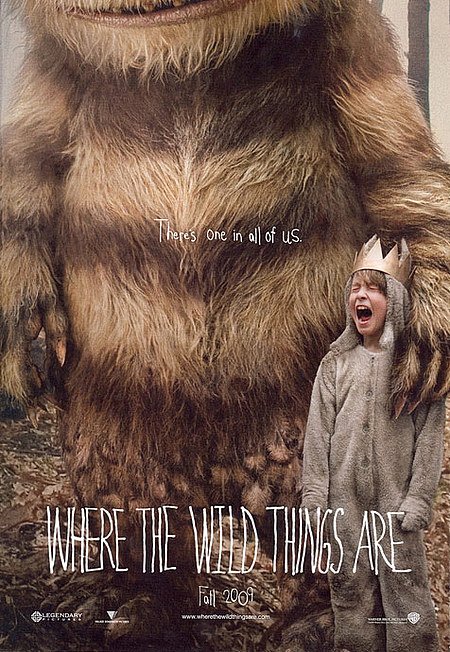
Where the Wild Things Are - A Third Review


Contrary to James Alison King Esq., I will tell you the ending and this ending serves as both a point of departure and return. I call it the 'mother gospel'. The movie begins with Max in the turmoil of creating something awesome and having idiots not appreciate his kick ass igloo. It is his mother that upholds the creation and welcomes Max's frustration as an opportunity to instigate more creation--she gives life to 'Max' (later when Carol asks Max 'what are you?', he claimed himself as 'Max'--using a tone eluding to the one that makes cool stuff for his mother). The point of departure for Max was realized in his mother's haphazard attempt at giving him 'life' in the sense of feeding him crap food. The contradiction of a mother that gives life by encouraging imagination but sometimes also through frozen corn did not sit well with Max. He peaced out to find a new life source--politics. He was met by friends and societal constructions that were both really fun to party with but also freaking annoying sometimes. Giving life to his friends proved impossible--he wished for them a mother. Max decided to head home. A mother with cake was waiting for him. Until all of our policy and societal constructions begin with the premise, 'How do we shape this policy so that it encourages and creates an environment for mothers to be mothers?', well, then I would imagine that we'll keep punching holes in each other's forts. Lucky are the ones that get to dominate cake and milk with a mother. White men should probably not speak for a few decades--at least this is what I think the message from Sednak and Spike is.


Tuesday, December 8, 2009

Zombieland - Timothy Johnson


The cold months of the year are always more suitable for horror films:Halloween, The Texas Chainsaw Massacre, The Ring and all six Saw films were released in the month October. However, the recent surge in zombie and post-apocalypse films cannot even be explained away by statistics: Pontypool, The Road, 9, The Book of Eli, and now Zombieland.If anyone can think of a reason why we are becoming more obsessed with the end of the world, please tell me. Could it be the climate change discourse?
The fact that films about the undead don't have to be scary has already been proven by Shaun of the Dead. As I only watched the latter a few weeks ago and did not like it, I had serious doubts whether I could enjoyZombieland. For all I knew, a spin-off of a mediocre movie would have to be even less funny. I was wrong. It is 81 minutes (that go by like 18) of laugh-out loud slapstick comedy. While killing zombies in every conceivable way, Woody Harrelson reminds us of how charming a Texas dialect can be - two years after No Country for Old Men made me want to talk like a backwater yokel.
The story is gripping, ingenious - and complete hogwash. A human adapted form of mad cow disease has spread throughout the planet and turned everyone into zombies. These can run pretty fast (considering they are half-dead) but also pretty dumb so it is easy to kill them with a baseball bat, banjo or -in one instance- a piano. We watch Woody Harrelson as he travels with three kids, the last survivors, through the post-apocalyptic USA. Two sisters are looking for an amusement park, because the younger one "has missed out on youth" and a teenage boy, Columbus, is looking for possibly surviving family members. What Tallahassee (Harrelson) is looking for we aren't so sure of, but it appears to be a Twinky. I shouldn't be telling you this because, well, the story is just not that important. What is important is that there are far more and better laughs than the trailer promises, something films like Men who stare at Goats could learn from. There are amazing (really,really-)slow-motion shots that look more like high-resolution photographs. The soundtrack is so appropriate that at times I caught myself headbanging in my seat to the tunes of Metallica, The Raconteurs and Van Halen. The film also makes you feel like you know the characters really well after only a few minutes. This is vital for a comedy because half the time we aren't laughing about the exact words said, but about the way they relate to the character who mouthed them. Zombieland even gets away with some cheesiness at the end that we are willing to forgive because it doesn't overdo it and -let's face it- is still a Hollywood film. Besides, director Ruben Fleischer makes up for this cheesiness by ensuring that truckloads of artificial blood are shed.
When asked about the film, Harrelson declared that in real life he doesn't carry guns, drive humvees AND does not like Twinkies. Be that as it may,Zombieland takes us back to his trigger-happy days of Natural Born Killers, appeals to action, comedy and horror fans alike and to me is the comedy film of the year.

John Daly - My Life in the Rough


Can't wait for this!

http://sports.espn.go.com/golf/news/story?id=4724222

According to Daly, Kevin James is going to play 'fat Daly' and Matt Damon will play 'skinny Daly'. I honestly can't think of a movie that I would enjoy more than this. I love John Daly. Follow him on twitter for genuine enjoyment. http://twitter.com/PGA_JohnDaly


Thursday, November 26, 2009

Two Brief Re-Reviews: Thoughts on Away We Go and Inglourious Basterds - By Robert Culpepper


Part I:
In a sentence, I would describe Away We Go as a study of American kids sans ambition who want to be responsible with their living, specifically in their family. The film lacks the cinene-scape of beautiful cross-country travel set to Aaron Copland, opting instead for episodic slices of cities across the land paired with Murdoch's mellow droning (Canada gets the strongest nod, strangely enough, though I bet if they'd visited in Winter it would have been a different story).

I think it gets the point across without indulging in that whole conversation of how the land is America and how America is the land and once we lose the wilderness we lose America and that's why we need to keep exploring outer space, etc (not bashing the environment, but the use of land as a character, a la westerns, On The Road, so forth). Instead of creating a visually beautiful film (think: Grand Canyon, Niagara Falls, the Pacific Coast HWY), the story is just about the people that inhabit that land. Which I think is nice. They have really common issues that are simple and complex at the same time. So many movies try to plug into mythic/primal themes and become pretentious. This film does the opposite and somehow manages to tap into an authentic human element.

Krasinski and Rudolph are both believable, which I didn't expect. And the cameos are brilliant-! Also, I cackled a lot during this movie, which was really fun. Most movies where I want to be the main character involve violence, good chase sequences, sex with girls who probably would carry disease in real life, some intrigue, and a twist. This movie has none of that, and I still want to be Bert.

Part II:
Inglourious Basterds is a beautiful film. As you probably know, QT- as I shall call him for the sake of laziness- makes cool films with interesting and novel storielines. His dialog is always amazing and he tempts that part of us that wishes we were all as smooth in real life as we imagine ourselves. However, I wouldn't say that any of his movies are 'beautiful,' until this one. I have never seen a movie shot with such a gorgeous palette. You should go back and watch it again just for the purpose of noticing how pretty the skin tones are. Then, watch it another time and pay attention to all the other colors and how freaking amazing they look, how rich and saturated but not too poppy or electric. Then, go watch any other movie ever made and compare. This movie should win an Oscar for cinematography because it is so pleasing to look at but doesn't include any gratuitous shots of the Alps, or the Pyrenees, or the Riviera. Even Paris is tame/blowing up!

Also, as Jones said, Christopher Wentz should win an Oscar for rocking so hard. Brad Pitt is good as comic relief, and I'm sure he helped sell tickets, but there was some really fantastic acting in this movie and it didn't come from this side of the Atlantic. I should also mention, for the sake of talking about more than the film stock and the lighting, that this is a film about film. It wouldn't surprise me if every shot is a reference to another movie (QT has an unbelievable knowledge of film history). Also, he panders to the French who have always loved him; he indulges in auteur-ism; he has the film critic die in a basement after making a stupid mistake (unlike Jones I appreciated the explanation of why the whole scene went down the way it did. To leave that up to obsessive QT fans to discover is to alienate the average viewer at an important crux of the story. And I think this movie, like all great movies, must be accessible to the 'everyman'). Basically, as you well know if you've seen it, this movie is awesome and should be studied in film classes at least as much as Annie Hall. Actually, I think a comparison of Woody Allen as writer-director of Annie Hall with QT as writer-director of Inglourious Basterds would be a hell of a paper to read. Think about how similarly they both end, protagonist stepping back from the action-as-theater and speaking directly to the camera....

Part III:
Both these movies are beautiful, but for very different reasons. As I see it, since that's true, it's also true that the human experience is wide-ranging and diverse. Which is cool. And that's why movies are great.

Saturday, November 14, 2009

The Invention of Lying - James A. King (Poofterliscious)

Don’t buy a ticket for Invention of Lying. If you sneak in, then stay only for the first ½ hour. This is the amount of time it takes to know the premise—nobody has ever lied until loser Ricky Gervais figures it out—and enjoy scenes like the Coke ad, where the only pitch they can come up with in a truth-only society is “we’re famous” (or even better, Pepsi’s add, “When you can’t get Coke”) Genuine chuckles for scenes like that. But by the half-hour mark, the premise has staled and you’re looking for the nearest exit as a biblically-bearded Gervais gives his ten commandments on pizza boxes. Get out of there.

For those of you too proud to admit the $10 mistake of purchasing a ticket for this film, or are in a situation like those teenage vandals that were under court order to watch Saving Private Ryan, fantasize about yourself in other, cooler movies. Here are some suggestions:

#1 You are a sea captain—grizzled and knowing. Your ship has just capsized off of Maricaibo and you are gasping for air as your head emerges above the frothy tide.

#2 You are a detective—bottle in hand, gun in pocket. Long legs and a mouth full of trouble have just walked in your door. You know you should say, “Get lost,” but you don’t.

#3 You are Forrest Gump—the sequel. Bubba Gump Shrimp has busted and you’ve taken to the bottle. You think you see Lt. Dan on the rain soaked streets of New Orleans as you stumble home to your bungalow. Adventures ensue.

Of course, as Invention of Lying shows, an interesting storyline is only a small piece of a quality flick. Gervais has an engaging idea and asks interesting questions about the necessity of dishonesty, but his reach exceeds his grasp. Big questions in a small movie spread the content too thin, precluding both entertainment and thought. We’ve seen this failing before in Robin William’s well intentioned “laugh/cry” movies like Jakob the Liar, Patch Adams, etc. Of course we’ve also seen comedy movies tackle serious issues/questions with great reult, as in Benigni’s Life is Beautiful. So what Gervais tries to do is not impossible, but rather inadvisable when you have to sacrifice entertainment, fun, and overall coherency to do so. My sea captain—grizzled and knowing— won’t be slipping on any banana peals.

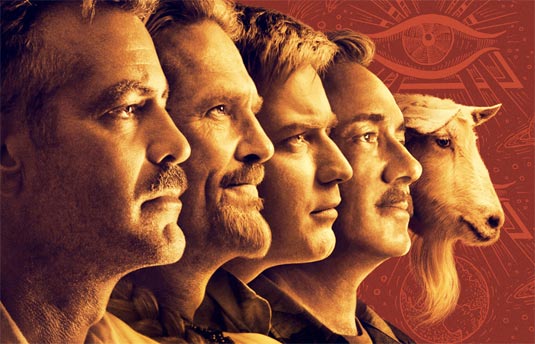
The Men Who Stare at Goats - By Timothy Johnston


Sometimes I wonder,

What if...
...the trailer had not already given away every single punchline?
...the scenes still had edges and were not as perfectly rehearsed and edited as they are?
...we were given a plausible explanation why Ewan McGregor ended up in the Middle East?
...this Allstar-cast had lived up to its name and wasn't put to shame by Stfephen Lang?
...the film was less full of itself?
...I had never seen Kubrick's Dr. Strangelove?
...this was not the film everybody is talking about?
...the director didn't try so hard to be a Coen Brother?
...it had at least one aspect you hadn't already heard beforehand?
...the joke about them being Jedi-soldiers had been made less frequently?
...a less prominent cast had been chosen, thus lowering expectations?
... the people around me hadn't laughed so hysterically, neutralising my risible muscles even more?
...I had smoked pot before seeing it?

Well, I think then I might have liked this movie.

Friday, November 6, 2009

An Education - Worth Seeing

Peter Sarsgaard is engaged to Maggie Gyllenhaal (degrees from a bunch of big-time schools, FHM's 58th hottest woman alive) who is the brother of Jake Gyllenhaal (friend of Lance Armstrong and Matthew Mcconaughey and star of a bunch of cult movies). Maggie and Jake are the children of Naomi Foner (couple of Oscars) and Steve Gyllenhaal (he has written an episode of Felicity). Their god-parents are Paul Newmann and Jamie Lee Curtis. In this movie, Sarsgaard plays the role of a dude that lives in a fantasy world. I would imagine that hanging around these aforementioned people would make it easy to play his role in this movie. Nonetheless, he was really freaking good.

Equally as tight as Sarsgaard, was Carey Mulligan. I'm debating on dating her or Princess Beatrice while I'm living in England. To belabor my boring interest with good actors, Alfred Molina and Emma Thompson were also great. I think Emma Thompson is one epic role short of being one of the greatest. I think she is as good as Meryl Streep and she doesn't carry the Hollywood obnoxiousness that Meryl Streep does. Which leads to thinking about British and American film. Which then leads to thinking about 'a country's' film.

It annoyed me how much people in the theatre were loving this movie towards the beginning. I felt like telling them that going to Oxford, appreciating art and music, Paris, and british puns are all really freaking annoying things and debatably racist, oppressive, and colonial. I think the reason I was annoyed is because I was being called out and I knew what was coming. I don't think the wealthy, indie-theatre supporters around me saw it coming. Had they seen it coming they might not have been chuckling and admiring the articulate, well versed, very London-british main characters. This script did a good job of making you think Paris is cool.

Turns out, in the end, we are all a bunch of frauds. People in Kensington still take shits. The British Museum is full of loot. Paris might be one of the most racially volatile cities in the world. Western Europe is not the center of the world. Going to Jazz concerts does not make you a philosopher. In contrast, learning, hanging out with your family, having some good friends, self-effacing, listening to people that know more than you, working hard at your job, being 'normal; is universal and therefore might be categorized as 'good'. The romanticism of engaging societal constructions with full blown desire to be 'better', in some way, is just that, romantic. Whereas, listening to your parents is not romantic but very real. This is not to say that by embracing humanity first we become less fraudulent. It just means that we recognize that the Eifel Tower does not define Paris--the people do. I think this would be the best thing to take from this movie.

Dune - Epic


If you have not read this book then you need to. The movie will seem really 'out-there' and just kind of unattainable, otherwise.

I am not a huge science fiction fan so I don't really have much to compare this to. I trust some of the science fiction-lover reviewers that I have read, though. I trust myself too to say that the book-movie combo of all that is Frank Herbert's and David Lynch's 'Dune' is nothing less than epic.

In my reviews I talk a good deal about interpretation. I am not a uniform reviewer in the sense that I don't 'understand' each movie in the same way, universally. My interpretation of the 'meaning' in a movie moves around. What is cool is that I think I don't really control this process. I believe that the movie pushes me into one mode of understanding as opposed to another (i.e. critic, artisan, ethnographer, iconographer, conversationalist, therapist, or deconstructionist). So maybe one of my subconscious determinants of how much I like or dislike a movie, is how well or how shitty the movie does of altering my means by which to watch it. I say this because I am very conscious of my claiming a movie as 'epic'. An epic movie, by my definition, meets two criteria: 1) the film is worth watching over and over again because the interpretations are inexhaustable, 2) The cinematography, soundtrack, acting, directing, producing, etc. is well done. 'Dune' (when combined with the book) is an epic movie.

(Ethnography, Iconography, Critic)

I don't know why I wasn't required to watch/read this when I was a freshman in high school. Actually, having just written that sentence I think it is because my freshman year was pre 9/11. Nonetheless, this story is an eerie allegorical narrative of terrorism and the war upon it. The similarities include: a desert people who live upon the most valuable natural resource in the universe, desert people that have been economically and socially oppressed, a desert people that are deeply religious and fundamentalist in their interpretation of texts and the mystical, a distant tyrant that purchases power with the militaristic aquisition of the natural resource, an uprising of the oppressed desert people, a jihad upon the distant tyrant, a mis-under-estimation (haha) of the prowess and eptitude of the desert people by the tyrant, and many other smaller, not less significant similarities. I truly would vote for a president in the United States during the next election that quoted 'Dune' and 'Seven Pillars'. In this sense, this movie-book combo is necessary for anyone preparing to aquiesce a bunch of oil with disregard for the well-being, infrastructure needs, religious and cultural histories of the people that live on top of the oil. Maybe, who it should really be read/watched by, are those that sit on top of the most bountiful fresh water supplies. This movie/book could be a manual for "how to defeat those that want your water." I think this is the future, at least.

(Conversationalist)

Dear Frank Herbert and David Lynch,

This past week, while living and going to school in London, I read your book and watched your movie. I wonder if you wrote/filmed with me in mind. The world has changed a lot since you worked on these projects. Did you know that jihad was going to be such a reality in the coming years? What was going on in the 60s, 70s, and 80s that I don't really know about? I hope no one tries to re-make this movie; however, I do wish it was about an hour longer. Thanks for making this movie and writing this book. I feel that by writing this review I may have an affect on your book and movie just as you have had an affect on me. Indeed, your work lives on.

Sincerely,
Kyle Douglas Jones

(Therapist)

I understand why it is that Lynch chose Kyle MacLaughlin to play Paul Muad'ib Usul Atreides. I suppose that he understands why I understand his choice for Lynch chose him with my world perspective in his mind. It makes sense, to me, that the fremen followed a white, intelligent, articulate, athletic male to the promised land. Had Herbert/Lynch chosen a black male, or even a black female for that matter, then we would probably have to work on the efficacy of our mutual transferences. After all, we all know that Jesus was white, spoke English, walked around with his arms out and palms up, and had a mullet.

(Deconstructionist)

This film seems to have been writen and filmed as if religion, culture, politics actually mean anything. Surely the prescribed, inherited trends of all the characters work within our socially constructed attempts at meaning. I mean, why even care about a narrative that chronicles the choices of men based upon a spice? All this movie and book really show is that we place emphasis and beliefs on things other than chance, which basically means that we base decisions on that which is not real. I think the Princess Irulan understood this. I wish she was more of a main character in the film as her narration in the book kept me interested and thinking.

I think you should check out this movie if you get the chance. Any high school english teacher that is reading this blog, you should make this movie part of your curriculum. Any western world leader that is reading this blog, you should watch out for the fremen under your iron fist and if you quote this book in your campaign speech I will vote for you. Any oppressed peoples that live upon oil or fresh water, you should watch this movie and read this book if you need a 'go-by' for how to wipe out your enemy (disclaimer: you will need a messiah prophecy to come true and I don't support jihad).

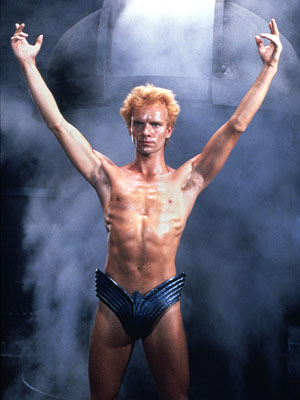
Oh, and Sting is in the movie.


Friday, October 23, 2009

Zatoichi - Fun


This movie is as awesome as the summer of TRL which featured daily battles between NSync, BSB, Limp Bizkit and Kid Rock. I used to come home from work just to watch the top three vids with this guy that lived in my basement that summer (he was supposed to be going door-to-door selling children's books but all he did was rock out really hard and watch TRL; he knew the dances to Bye Bye Bye, and I want it That way; he was tight).

For real though, this movie is great. I don't know how many samurai movies I have seen but it is a substantial number. The only one that I can ever remember the name of is 'Seven Samurai'. I think this is because I don't speak Japanese and because many of these movies are all quite similar. Zatoichi, however, I will definitely remember and I will name drop it, no doubt. Seeing this movie makes you cooler than everyone else. I can already tell though that when I name drop this movie during film society pub night everyone is going to be all like, "dude, I saw that movie at Cannes in like 94." But, I'll claim that it is still awesome.

The way I see it, there are two ways to make a samurai movie. 1) Make an epic archetypal that encompasses universal appeals to the human condition and societal views on justice and honor or 2) make a cut-em-up blood bath with a tragic (or non-tragic) hero that just destroys everyone and everything. This is a fine line and obviously many samurai movies fall into both categories but I think ultimately this is a good line of demarcation. At least, I think samurai movies would be better if they chose one of the two paths (i.e. Twilight Samurai vs. Kill Bill; I think both are great because they chose a path).

Zatoichi, however, is different; transcendental I might say. I mean we are talking about taking an icon of the Samurai industry (Zatoichi is an epic character that has been made and re-made a bunch of times in Samurai film) and putting him inside a comedy/musical. What a great idea? It makes one question the placing of Japan in the 'east' as opposed to the 'west'. I feel like a really good scholarly article, at least one I would think is cool, would talk about how Japanese cinema relegates the classification of an 'eastern' nation and resolutely claims, "We are are not and forever will be western." And then a cool follow up article, (like, if I am a friend of the dude that wrote this first article, I would cite his article so that he gets some dough stacks for being cited and write a second article) would be about how Japanese cinema doesn't care about the classification of 'western' or 'eastern' because it just wants to be 'Japanese'. But then again this may be to pomo for it's own good. But then again, Japan might totally dig this idea and make a movie about this idea.

At any rate, Zatoichi chronicles the several days that a blind samurai master spends amongst some villagers that are being held in economic captivity by an oppressive gangster. He decides that this is not cool so he takes out the gangsters. He kills quickly which is welcomed as most samurai fights were probably pretty quick with very little steel hitting steel. There are some cool shout outs to 'Seven Samurai' and a lot of great dialogue. Ultimately though, this movie ends in a dance sequence. I didn't like 'Slumdog Millionaire' until the dancing. I liked this movie before the dancing which means I loved the movie after the dancing. I guess I just love some choreographed dancing; I owe this to me being brought up on season tickets to Broadway shows and The Sound of Music.

I highly recommend this movie. I'm going to watch it again.


Wednesday, October 21, 2009

The Imaginarium of Dr. Parnassus - I mean it's tight - By KDJ

It sucks so much that Heath Ledger isn't going to be making anymore movies. There are probably other things in the world that suck more, but he is just so freaking good at acting.

This movie did not change my life. I was kind of hoping that it would. I don't even know what that means. But it probably means that I won't buy the DVD but I'm sure I'll see it 15-20 more times in my life because this movie is just going to be 'around', make no bones about it. I compare it to writing an undergraduate thesis or dissertation. You spend an entire semester meeting with a professor, pretending to read all the books he/she tells you to read, you write like five drafts and finally hand in a 35 page paper with a three page bibliography. Most likely, your paper isn't that awesome or life changing but you spent tons of time on it so the professor has to give you at least a B+. This theory isn't true for all movies; Land of the Lost spent tons of money and had a huge cast but we, the professors, the audience, gave this movie crap marks. At any rate, I believe my theory applies to Parnassus. The script is really detailed and really deep and if it had citations it would probably cite Kant, Obama, Genesis, the Koran, and Niebuhr. Which is cool and all, but it's not a life changing dissertation. What is more (my chinese friends taught me to use this phrase; it is really fun to use in casual conversation {i.e. "Kyle, I burnt my dumplings, and what is more, I dumped my girlfriend."}), if you put Heath Ledger, Johnny Depp, Colin Farrel, Jude Law, Christopher Plummer, Tom Waits and a bunch of other cool actors in a film, you at least are going to get big crowds in the theatres. SO, don't get too jacked about this movie but do get kind of jacked cause it is still pretty tight.

The dualism of imagination and narrative vs. naturalism/humanism/agnosticism etc. is at the core of this movie. This is a cool premise on which to make a movie. Dualisms make life easy and they give one an opportunity to do tons of cool stuff on crazy tangents but it is always easy to come back to your thesis (for instance, in this movie, the issue of institutionalizing charities - not being able to tell Greenpeace apart from Shell because they both wear suits now but relaying this back to dualism of stories vs. prescription). While reality isn't always dualistic in nature, Dr. Parnassus' imaginarium is, and thus, you get lots of CGI coolness. Along this thought line, I am really interested in cubism right now. The idea of painting an object as it appears in reality - that being from every single (infinite) vantage point. What would a movie look like that tried to do this? Could be really far out. I think someone should make a cubism musical. I would want Joel Davis to write the score and Joey Profitt to be artistic director and this super annoying pedant in my graduate college program to direct it and all my friends from home to think of the most annoying, lame things in society and have this be the subject of the script which would be written by sixth graders.

You should see this movie because Heath Ledger proves that he is better than all the other all stars that are also in this film. It is inpirational. It is not entirely predictable. Terry Gilliam has been given permission to be as creative and crazy as he wants--which is a good thing. The physical depiction of London vs. the social London is cool and interesting to social science geographers. The CGI in this movie is just stupid awesome. It's ultimately just kind of a fun movie. The trailer made me think it was going to change my life, it did not, but it is still really cool.